
Bracelet Size Chart Men
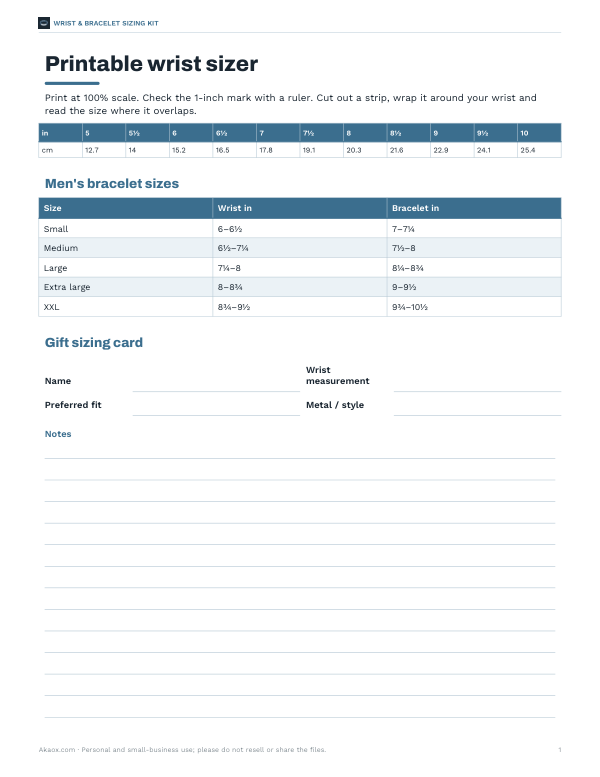
Measure your wrist, choose how you like a bracelet to fit, and the size finder gives the bracelet length to buy. The chart covers typical men's sizes from small to extra large and how chain, beaded, leather and cuff bracelets differ.
- Free to use
- No sign-up
- Runs in your browser
Find your bracelet size
Men's bracelet size chart
| Size | Wrist (in) | Wrist (cm) | Bracelet length (in) | Bracelet length (cm) |
|---|---|---|---|---|
| Small | 6–6½ | 15.2–16.5 | 7–7¼ | 17.8–18.4 |
| Medium | 6½–7¼ | 16.5–18.4 | 7½–8 | 19.1–20.3 |
| Large | 7¼–8 | 18.4–20.3 | 8¼–8¾ | 21–22.2 |
| Extra large | 8–8¾ | 20.3–22.2 | 9–9½ | 22.9–24.1 |
| XXL | 8¾–9½ | 22.2–24.1 | 9¾–10½ | 24.8–26.7 |
Wrist & Bracelet Sizing Kit
A printable paper wrist sizer, full bracelet and watch strap size charts, and a gift sizing card to fill in.
- Printable wrist sizer & charts (PDF, DOCX)
Formats: PDF, DOCX. Instant download after payment (link valid 72 hours, up to 5 downloads). AI-assisted: the templates were drafted with AI help and reviewed and laid out before publishing.
$3.00 USD, one-time
- Instant download
- 7-day refund
- Secure checkout by Stripe
7-day money-back guarantee. Full refund within 7 days of purchase, even after you download.
Full refund within 7 days — see the refund policy and license.
Free printables
Single sheets you can print right now, no sign-up. The full pack adds every sheet in one download plus the editable files.
How to measure your wrist
- Use a soft tape measure, or a strip of paper or string.
- Wrap it around your wrist just below the wrist bone, where a bracelet or watch sits.
- Keep it snug against the skin but not tight.
- Mark where it meets, then lay the paper or string flat against a ruler.
- Measure your dominant wrist too if you might wear the bracelet on either arm; it is often slightly larger.
Measure at the end of the day if you can: wrists can be a little larger in warm weather or after exercise. If you are buying a gift, measure a bracelet or watch strap the person already wears comfortably, from end to end including the clasp.
Wrist size versus bracelet length
Bracelets are sold by their total length, and that length must be larger than the wrist so the bracelet can move and close comfortably. How much larger depends on how you like it to sit:
| Fit | Add to wrist | How it feels |
|---|---|---|
| Snug | about ½ in (1.3 cm) | Sits close, moves little, good for thin chains and stacking |
| Comfort | about ¾ in (1.9 cm) | The most common choice; turns freely without sliding over the hand |
| Loose | about 1 in (2.5 cm) | Relaxed drape, looks casual, can slide toward the hand |
Thicker bracelets use up more length inside the circle, so wide links and heavy chains need an extra quarter inch or so. Stretch beaded bracelets are usually sold closer to wrist size because they expand to go over the hand.
Different bracelet types
- Chain and link bracelets — curb, figaro, Cuban and rope chains follow the length rules above; wider chains (8 mm and up) need a little extra length.
- Beaded bracelets — on elastic cord, sized close to the wrist measurement, often about ¼–½ inch larger; beads 8 mm and larger need more.
- Leather and cord — often have sliding knots or multiple snap positions, so check the adjustable range.
- Cuffs — open at the back and sized by the inner circumference or wrist range; adjust by gently squeezing or opening in small steps.
- ID and bar bracelets — the rigid plate adds stiffness, so a comfort fit is usually best.
Worked example
Your wrist measures 7 inches and you prefer a comfort fit. Adding ¾ inch gives 7¾ inches, which is a medium in most men's sizing. For a heavy 10 mm Cuban link chain, add another ¼ inch: an 8-inch bracelet. For a stretch bead bracelet with 8 mm beads, 7¼–7½ inches would be typical.
Average men's wrist sizes
Men's wrists vary widely with frame and build. Many men measure somewhere between about 6½ and 7½ inches, which is why many jewellers treat 8 inches as a standard men's bracelet length. Larger frames and athletes often measure 8 inches or more and need extra-large sizes. Measuring is always better than assuming the average.
Adjusting a bracelet that does not fit
A jeweller can shorten most link and chain bracelets by removing links, and some can add an extension chain for a little extra length. Clasps with multiple positions, such as box clasps with fold-over safeties, sometimes allow small adjustments. Beaded bracelets can be restrung on new elastic with beads added or removed. Solid cuffs can usually be opened or closed slightly, but avoid bending the same spot repeatedly, which can crack the metal.
Watches and bracelets together
If you wear a bracelet with a watch, a snug fit on the bracelet stops it sliding over the watch case and scratching it. Many people wear the bracelet on the other wrist, or place a slim bracelet above the watch on the same arm with a little space between. For watch straps, the same wrist measurement applies, and many strap makers publish wrist ranges for their short, regular and long lengths.
Caring for men's bracelets
Take bracelets off for swimming, heavy lifting and cleaning with chemicals. Chlorine and household cleaners can dull or discolour metals, and impact can stretch links or break clasps. Store chains flat or hanging so they do not tangle, and keep leather away from prolonged moisture. Wipe stainless steel and gold with a soft cloth; silver benefits from a polishing cloth when it tarnishes. Check clasps periodically — a worn clasp is the most common reason a bracelet is lost.
Frequently asked questions
What is the standard men's bracelet size?
Around 8 inches (20 cm) is the most common men's bracelet length, fitting wrists of roughly 7–7¼ inches.
How much bigger than my wrist should a bracelet be?
About ½ inch for snug, ¾ inch for comfort and 1 inch for a loose fit.
What size bracelet for a 7-inch wrist?
About 7½ inches for snug, 7¾–8 inches for comfort, and 8 inches for loose.
Do thicker chains need to be longer?
Yes, add about ¼ inch for chains 8 mm or wider, because the thickness takes up length inside the circle.
How do I size a cuff?
Use the maker's wrist range or inner circumference; cuffs are adjusted by gently bending.
Can I measure with a phone charger cable?
Any non-stretchy string or paper strip works; mark it and measure against a ruler.
What if I am between sizes?
Choose the larger size for chains and the smaller for stretch beaded bracelets.